Illalu Kathalu (Kitchen Films)
N Lavanya Ramaiah / Short Documentary / India / Telugu / 21:47 / 2024
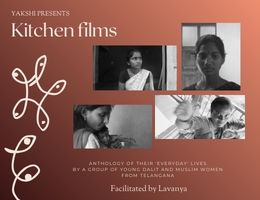
Kitchen Films emerged from a year-long series of participatory workshops held at Kudali, Badampet, in the Sangareddy district of Telangana. The workshops were produced by Yakshi- a resource and creativity centre for rural women, youth and children established in 1992.
The films were facilitated by Lavanya Ramaiah, whose film practice privileges the intimate and everyday over the spectacular. In these sessions, a group of young rural women—most of them mothers and wives who had never before touched a camera—began exploring filmmaking as a medium of self-expression. What began as an introduction to cinematic language became a profound inquiry into selfhood, agency, and the politics of representation.
The name Kitchen Films itself carries multiple resonances. It refers to the domestic space that shapes the women’s everyday lives and the social roles they inhabit, while also reclaiming that very space as one of creativity and authorship. Within the constraints of domesticity—its routines, repetitions, and invisibilities—these filmmakers discovered a cinematic vocabulary grounded in lived experience. Their cameras turned toward what is often dismissed as trivial: a pot simmering on the stove, the sound of chores, the gesture of care. In doing so, they transformed the private into the political.
Initially conceived as part of a fellowship program engaging with ideas of liberty and constitutional rights, the project soon moved beyond abstraction. As the women filmed their homes, conversations, and silences, what surfaced were the layered inequities that define domestic life. Their stories revealed forms of intimate violence—psychological, emotional, and structural—that are rarely spoken but deeply felt. The films are not confessional in a conventional sense; rather, they are acts of quiet witnessing. Each film bears the imprint of a specific life, yet together they form a collective portrait of gendered experience in rural India.
The tone of the Kitchen Films oscillates between tenderness and critique. They are personal and humorous, yet sharply observant of how power and control operate within households. Everyday labour—cooking, cleaning, caring—is rendered with an unsparing eye and subtle irony. This gaze, both self-reflexive and empathetic, situates the filmmakers within a lineage of feminist art practices that question the politics of visibility.
For Lavanya Ramaiah, the facilitation of Kitchen Films became an act of co-learning. Working closely with the participants, she reflected on how instinctively they navigated the “politics of the personal.” Their engagement raised difficult questions about the nature of authorship and access in cinema:
How can the time-intensive and resource-heavy process of filmmaking become meaningful within the overburdened routines of women’s lives? Is cinema still a privilege reserved for those with social and economic mobility—largely men? What would Indian cinema look like if more mothers, wives, workers, and farmers could tell their own stories? Can access to the tools of cinematic expression truly be democratized?
Through such questions, Kitchen Films becomes more than a creative project; it is a social and aesthetic intervention. The films reveal how storytelling can serve as both resistance and release, how the act of filming can transform passive observation into authorship. The process itself—sharing, shooting, watching—becomes a mode of solidarity.
In their modest scale and emotional precision, these films reimagine cinema as an extension of everyday life rather than an escape from it. They affirm that the kitchen, often seen as a site of confinement, can also be a site of artistic origin—a space where women reclaim narrative control and redefine what filmmaking can be.
Cast & Crew: Shravani, Sarita, Lahiri, Afreen, Gopika, Bharati, Anuradha, Lavanya, Athiya, Mamatha, Varalakshmi, Santosha, Mounika, Tayyaba, A.Lata, V.Lata, Maria, Akansha, Madhavi, Ashwini, Suvarna B, Suvarna T, Peashanti, Sakeena, Anjum, Swati, Ramadevi, Sangeeta, Devrani worked as Camera crew and cast.
Director’s Bio
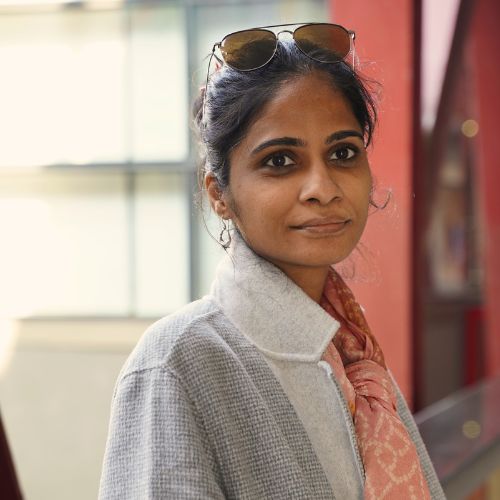
Lavanya is a film editor, with a diploma from Film and Television Institute of India.
She is interested in exploring interfaces between Art, Ecology, Community and film. She has facilitated film-making workshops in Telangana, Maharashtra and Arunachal Pradesh, to explore expressions on gender, caste, labour and local livelihoods, among Adivasi and caste-oppressed communities.
To listen and assist others as they tell their stories through films, is how she deepens her own practice and learning in Cinema.