

Welcome to the 21st Edition of the Asian Women’s Film Festival
DAY 2 - Saturday, 14th March 2026 | Multipurpose Hall
Experimenting With The Moving Image
Workshop hosted by Vani Subramaniam
14th March 2026
Multipurpose Hall, Kamala Devi Complex, India International Centre, New Delhi
2 PM – 6 PM
Does working with the moving image inevitably mean working on a film?
What happens if established relationships of the moving image with context, linearity, authenticity and storytelling are disrupted? Are new meanings created when it interacts with objects, spaces, scale, memory or fantasy? What chemistries does it generate when it encounters the gendered, casted, communalized, censored body of our times?
ON SCREEN/OFF SCREEN is a workshop for filmmakers and artists across diverse disciplines, interests and generations who share a love for the film medium, a desire to experiment with it, readiness to rethink their relationship/s with it, and the spirit to enjoy the magic that can happen when open minds meet and explore possibilities together.
Registration fee: Rs. 500/-
(With tea and refreshments on the house!)

Vani Subramaniam

Keiko Okawa
Reena Mohan
Keiko Okawa (Filmmaker, Editor, Japan) in conversation with Reena Mohan
Day 2 — 14 March | CD Deshmukh Auditorium | 11:15 AM
C.D Deshmukh Auditorium, IIC, New Delhi
For Registered Delegates
Keiko Okawa born in Ishikawa Prefecture, 1978. Okawa has a degree from the Graduate School Film and New Media, Tokyo University of the Arts. She worked on Yuki and Nina(2009, dir. Suwa Nobuhiro)as an assistant editor. She also edited on Haruhata-san’s Recorder(2022, dir Sugita Kyoshi) and Small, Slow but Steady (2022, dir.Miyake Sho).and Following The sound(2023,dir,Sugita Kyoshi).and After The Fever (2024, dir.Yamamoto Akira), and All The Long Nights (2024, dir.Miyake Sho), and Super Happy Forever(2024, dir.Igarashi Kohei), and Seaside Serendipity (2025, dir. Yokohama Satoko), and Two Seasons, Two Strangers (2025, dir.Miyake Sho). She directed Oasis(2023). She also participates as a lecturer for “Children Meet Cinema,” a Japan-wide educational film workshop.
Reena Mohan is an award-winning independent documentary filmmaker and editor who has worked out of Dubai, India, Kathmandu, and London.
She graduated from the Film & Television Institute of India in 1982 and, since then, has edited features, television serials, and over 50 documentaries, many of which have been screened at international film festivals.
She produced and directed her first award-winning documentary, Kamlabai, in 1991 and has, till now, scripted and directed more than 10 documentaries. Most of these have travelled to various international film festivals. Her films reveal a passionate engagement with people’s lives and issues of filmmaking.
She has several awards, including three National Awards to her credit.

Paromita Vohra

Subasri Krishnan
Paromita Vohra (Filmmaker, India) in conversation with Subasri Krishnan
Day 3 — 15 March | 10:45 AM
C.D Deshmukh Auditorium, IIC, New Delhi
For Registered Delegates
Paromita Vohra is a filmmaker and writer whose work focuses on gender, feminism, urban life, love, desire and popular culture and spans many forms including documentary, fiction, print, video and sound installation. Her films include the path-breaking Unlimited Girls and Q2P as well as Partners in Crime, Morality TV and the Loving Jehad, Where’s Sandra, Cosmopolis: Two Tales of a City and A Woman’s Place.
She recently directed the cutting-edge prime time TV series Connection Hum Tum. She has written the internationally released Pakistani film Khamosh Pani (Silent Waters) and several documentaries. Her writing has been published in various anthologies including Bombay Meri Jaan: Writings on Mumbai, The Tranquebar Book of Indian Erotica, The Penguin Book of Schooldays, Defending Our Dreams and First Proof and journals, including Signs, South Asian Journal for Popular Culture, Bioscope, Tehelka, Elle, Outlook, vogue, India Today and Yahoo Originals.
She writes weekly columns in Sunday Mid-Day and Mumbai Mirror and is currently working on a multi-media online project around sexual experience and sex education and a film about Hindi film music obssessives.
Subasri Krishnan is a filmmaker and leads the Media Lab at the Indian Institute for Human Settlement (IIHS), an educational institution that works around urban issues. Subasri’s films are on various themes concerning contemporary politics. Her award-winning films include This or That Particular Person. Subasri has worked extensively in Assam. Her other films include What the Fields Remember; Sikhirni Mwsanai (Dance of the Butterfly) her forthcoming film is Shadow Lines based in contemporary Assam.
Nina Sabnani
Anne Doshi
Fida Hamid
Isha Mangalmurti
Masterclass by AniMela Film Festival
Masterclass by AniMela Film Festival With Nina Sabnani, Anne Doshi, Fida Hamid & Isha Mangalmurti
Day 3 — 15 March | 2:15 PM
C D Deshmukh Auditorium, IIC, New Delhi
For Registered Delegates
Nina Sabnani is an artist and storyteller who uses film, illustration and writing to tell her stories. She graduated in painting from the Faculty of Fine Arts, Vadodara and received a master’s degree in film from Syracuse University, NY, which she pursued as a Fulbright Fellow in 1997.
Her doctoral research at the IDC focused on Rajasthan’s Kaavad storytelling tradition.
Nina’s research interests include exploring the dynamics between words and images in storytelling.
Her work in film and illustrated books, seeks to bring together animation and ethnography.
After teaching for two decades at the National Institute of Design, Ahmedabad, Nina has made Mumbai her home.
Currently, she is Professor at the Industrial Design Centre, IIT Bombay.
Anne Doshi is Co-Founder and Artistic Director at AniMela.
Isha Mangalmurti is an independent 2D animation filmmaker based in India. She has a keen interest in local indigenous stories and is constantly exploring ways of telling these through her work.
Entering an industry in its nascent stages right after graduating from NID, Ahmedabad in 2017 pushed her towards a more entrepreneurial direction.
Isha enjoys designing visual narratives and bringing stories to life. Her aim is to create worlds where people can escape reality for some time. She is currently developing a mini-series targeted towards young adults set in India revolving around the topic of women’s football. Isha strives to keep her work authentic to the contemporary Indian reality, treading a fine line between fiction and non-fiction. She believes animation has the power to help us imagine a better future. She wants to bring 2D animation to the mainstream in India and put the country on the international map for it.
Questions in and of Film Pedagogy
A Room of Our Own · Supported by the JCMF Fellowship
14th March 2026 2.00 pm – 4.30 pm (with a 15-minute tea break)
Conference Hall, India International Centre
Open for students & registered delegates
Moderators: Janaki Abraham & Surabhi Sharma
Participants: Shohini Ghosh · Sameera Jain · Asha Achy Joseph · Maheen Mirza · Rajula Shah · Shai Heredia · Iram Gufran · Pinki Brahma Chaudhary · Ruchika Negi · Mausami Bhattacharyya · Gauri D. Chakravorty · Deepti Khurana
The desire to organise this discussion has emerged from the project,‘A Room of Our Own’, partially supported by the JCMF fellowship . One of the key questions that emerged during our research was the ways in which cinema was formulated as an essentially masculine industry and thus film pedagogy was designed and imparted by male faculty who reproduced this trope. Questions around gender representation amongst students and faculty were seldom seen as relevant to the formation of our film schools. Pedagogy revolves around the work of male masters with little or no attempt to problematize the gaze. In recent years, students who have flagged these concerns have been met with hostility not only by the institution but to an extent by the faculty and student community as well. In contrast, media schools seemed to allow for a far more expansive and inclusive understanding of concerns around gender and were actively engaged with the issues raised by the feminist movement. However, this exchange between institutes teaching “Cinema” versus those who have allowed the discipline to include media, art, film practices remains non-existent.
The discussion is designed as a conversation. As teachers teaching in different institutional contexts, we invite you to share your experiences, challenges and strategies. What are the questions before us in a rapidly changing mediascape? How do we discuss the politics of image making amidst over-saturated media noise? What are the ways in which our teaching and institutions can make space for marginalised ways of seeing, and speaking?
Surabhi Sharma

Ruchika Negi
Mausumi Bhattacharyya

Gauri D. Chakraborty
Deepti Khurana

Prachee Bajania
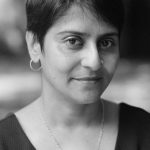
Tanushree Das

Tillotama Shome
Prachee Bajania in conversation with Tanushree Das and Tillotama Shome
15th March 2026 2.00 pm – 06:15 PM
CD Deshmukh Auditorium, India International Centre
Seating is first come first served for the registered audience.
Closing Ceremony followed by screening of Baksho Bandi (Shadowbox) and Conversation.